The answer takes us back thousands of years to Greek mythology and the story of Orpheus, one of the most gifted musicians and poets in ancient legend.
Orpheus was said to possess such extraordinary musical talent that when he played his lyre, people, animals and even nature itself would stop and listen. His music could calm conflict, inspire hope and bring people together. He became renowned not only for his artistic ability but also for the power of music to connect, heal and transform lives.
The story most often associated with Orpheus is his devotion to his wife, Eurydice. After her death, Orpheus was so heartbroken that he journeyed into the Underworld to bring her back. Moved by the beauty of his music and the strength of his love, the rulers of the Underworld agreed to release her on one condition: he must lead her back to the world above without turning to look at her until they had both reached the surface. Tragically, just before the journey was complete, Orpheus looked back and Eurydice was lost to him forever. Despite its sadness, the myth is remembered as a powerful story of love, courage, perseverance and the transformative power of the arts.
When the Orpheus Centre was founded in 1998, the name reflected a strong connection with music and the belief that creative expression can unlock potential and change lives. However, while music remains an important part of our identity, Orpheus has evolved significantly over the years. Today, we are an inclusive arts college, offering opportunities across a wide range of creative disciplines including performing arts, drama, dance, music, digital media and visual arts. Our name continues to honour our origins, but it also represents a much broader vision of an inclusive world where disabled young people, with a passion for the arts and desire to live and work independently, can achieve their aspirations.
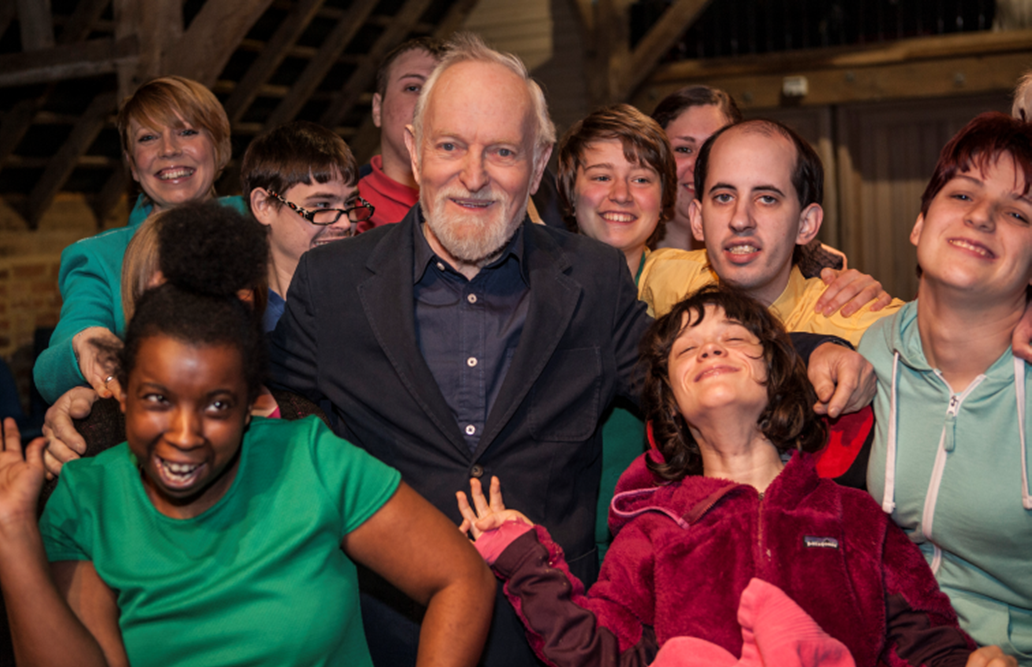
The Orpheus Centre is named thus because Orpheus was the greatest musician who probably never lived! Jason and his Argonauts took him with them on their mythical ancient Greek travels, and sent him ashore first whenever they arrived at an island where the natives might not be friendly, because when Orpheus sang his songs and played his lyre the world calmed down and listened.– Sir Richard Stilgoe, Orpheus Centre Founder
Tragically, Orpheus’ wife Euridice was killed by a snake, and descended into the underworld. Orpheus persuaded Apollo his father to allow him to go down to the underworld and rescue her, but Apollo made one condition – that Orpheus was never to look back at her, until both were out in the sunlight. Orpheus disobeyed this unreasonable command and looked back – and lost his wife forever. So at Orpheus, our motto has always been ‘Never look back!’
The first song I ever wrote with the students went
NEVER LOOK BACK, NEVER LOOK BACK,
YOU WILL STOP THE WORLD I IS TRACK.
NEVER LOOK BACK, ALL YOU WILL SEE
IS THE WORLD THE WAY IT USED TO BE.
At Orpheus we help our students to create a new view of the world – not the world the way it used to be!
Even our distinctive Orpheus blue has its roots in Greece. The colour was chosen to evoke the beautiful waters of the Aegean Sea, connecting us to the Greek origins of the Orpheus myth and the rich cultural heritage from which our name is drawn. It serves as a reminder of creativity, exploration and possibility.
So, when people ask why we are called Orpheus, the answer lies in a timeless story about the power of creativity to inspire, connect and transform lives. While our roots are in music, our journey has seen us grow into a vibrant arts college where young disabled people can find their voice, express themselves and realise their potential through many different creative pathways.